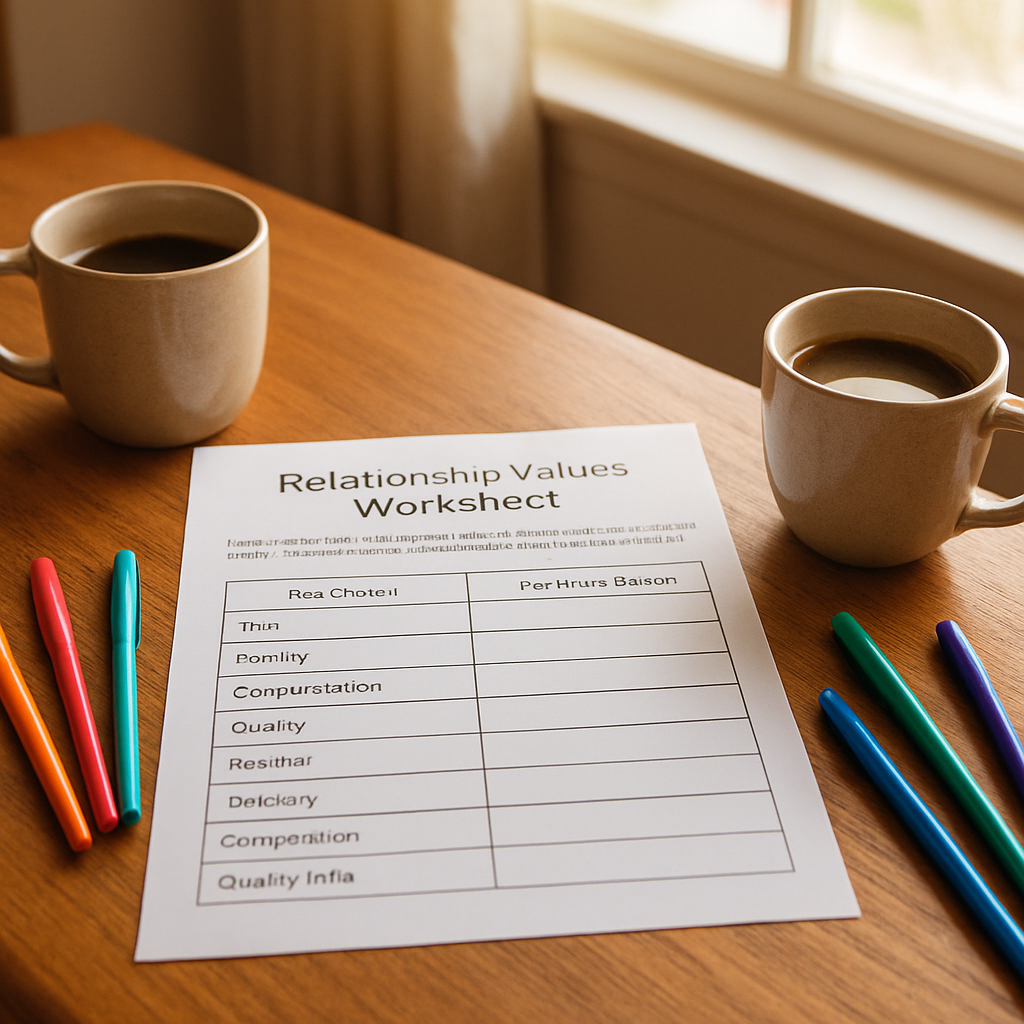
Imagine sitting at your kitchen table with a fresh cup of coffee, scrolling through a worksheet that promises to surface the core values you and your partner hold dear. It feels a bit like opening a treasure map of your relationship, right?
That’s exactly what a relationship values worksheet PDF does – it nudges you to name, discuss, and prioritize what truly matters, whether it’s financial security, adventure, family time, or personal growth. When you actually write these values down, they stop being vague ideas and become concrete commitments you can reference during tough decisions.
Take Sarah and Mark, for example. They’d been arguing about how much to spend on a vacation versus saving for a house. After filling out the worksheet together, they discovered that “experiencing new cultures” ranked higher for both of them than “luxury accommodations.” That simple insight shifted their plan to a modest road trip, saving money while still honoring their shared value of adventure.
So, how do you get started? Here’s a quick three‑step routine you can try tonight:
- Set aside 30 minutes with no distractions. Grab a pen, your partner, and the PDF.
- Individually list your top five relationship values, then share and discuss each one. Look for overlaps and note any surprises.
- Agree on three core values to prioritize in the next month. Write them in a visible spot – a fridge magnet or a shared journal.
Feeling stuck? You might benefit from additional tools that spark deeper conversation. Our Effective couples communication exercises PDF guide offers step‑by‑step activities that pair perfectly with the values worksheet, turning abstract discussions into playful, actionable moments.
And once you’ve clarified what you both cherish, consider celebrating those values with a tangible reminder. A custom keepsake from a thoughtful gift shop can serve as a daily visual cue of your commitment. Check out unique relationship gifts that echo the themes you’ve identified – whether it’s a engraved compass for adventure lovers or a hand‑crafted “home” sign for those focused on stability.
By the end of this exercise, you’ll have a clear roadmap that guides budgeting, goal‑setting, and everyday choices. It’s not just a piece of paper; it’s a living document that evolves as you grow together. Ready to turn values into actions? Let’s dive in and make those conversations count.
TL;DR
The relationship values worksheet PDF helps you and your partner quickly identify, discuss, and prioritize the core values that drive your decisions, turning vague wishes into concrete commitments you can reference every day.
Use the simple three‑step routine to create a shared values board, keep it visible, and watch your communication and budgeting improve within weeks.
Step 1: Download the Relationship Values Worksheet PDF
Alright, you’ve got the idea of why the worksheet matters—now let’s actually get it into your hands. The first thing you’ll do is click the download button, save the PDF to your laptop or phone, and print a copy (or keep it digital if you prefer). It’s that simple, but the magic happens when you set the scene.
Find a cozy spot—maybe the kitchen table with that fresh coffee, or a sunny corner of your living room. Turn off the TV, silence your phone, and give yourselves a solid 30‑minute window. No emails, no chores, just you, your partner, and the worksheet.
Before you dive in, grab a couple of pens in different colors. One for each of you, or one for “ideas” and another for “final choices.” Having that visual cue makes the process feel more like a collaborative art project than a chore.
Now, open the PDF. You’ll see three main sections: a quick values brainstorm, a ranking grid, and a space for actionable commitments. Start with the brainstorm—each person silently writes down five values that feel core to the relationship. No discussion yet; just raw thoughts. You might end up with things like “adventure,” “financial security,” “family time,” or “personal growth.”
Once both lists are ready, swap papers and read each other’s entries out loud. This is where the connection deepens. You’ll notice overlaps—maybe you both love “growth” but phrase it differently. Highlight those common threads.
Here’s a tip: if a value feels vague, ask yourself, “What does that actually look like day‑to‑day?” For example, “trust” might become “checking in with a quick text during the day.” That specificity turns abstract ideas into concrete actions.
When you’ve clarified each value, move to the ranking grid. Together, decide which three should be your top priorities for the next month. Write them large in the commitment space. This becomes your shared roadmap.
Feeling stuck? You might find it helpful to pair this exercise with some effective couples communication exercises pdf guide to keep the conversation flowing and prevent it from slipping back into old patterns.
Now that you have your top three, think about how you’ll keep them visible. A sticky note on the fridge works, but why not make it a little more special? You could order a custom wooden token from Poppas Wooden Creations—maybe a small engraved heart that lists your three values. Every time you see it, you’re reminded of the promise you made together.
Or, if you’re looking for a fun, tangible reminder, check out Midnight Scriber. They have quirky, meaningful gifts that can double as conversation starters and daily affirmations of what matters most to you both.
Finally, schedule a quick “values check‑in” for next week. Put it on your calendar, set a reminder, and use the worksheet’s commitment space as your agenda. This keeps the momentum alive and shows you both that these values aren’t just a one‑time exercise.
That’s it—download, print, brainstorm, rank, and display. In under an hour you’ve turned vague hopes into a concrete plan you can both see and act on.
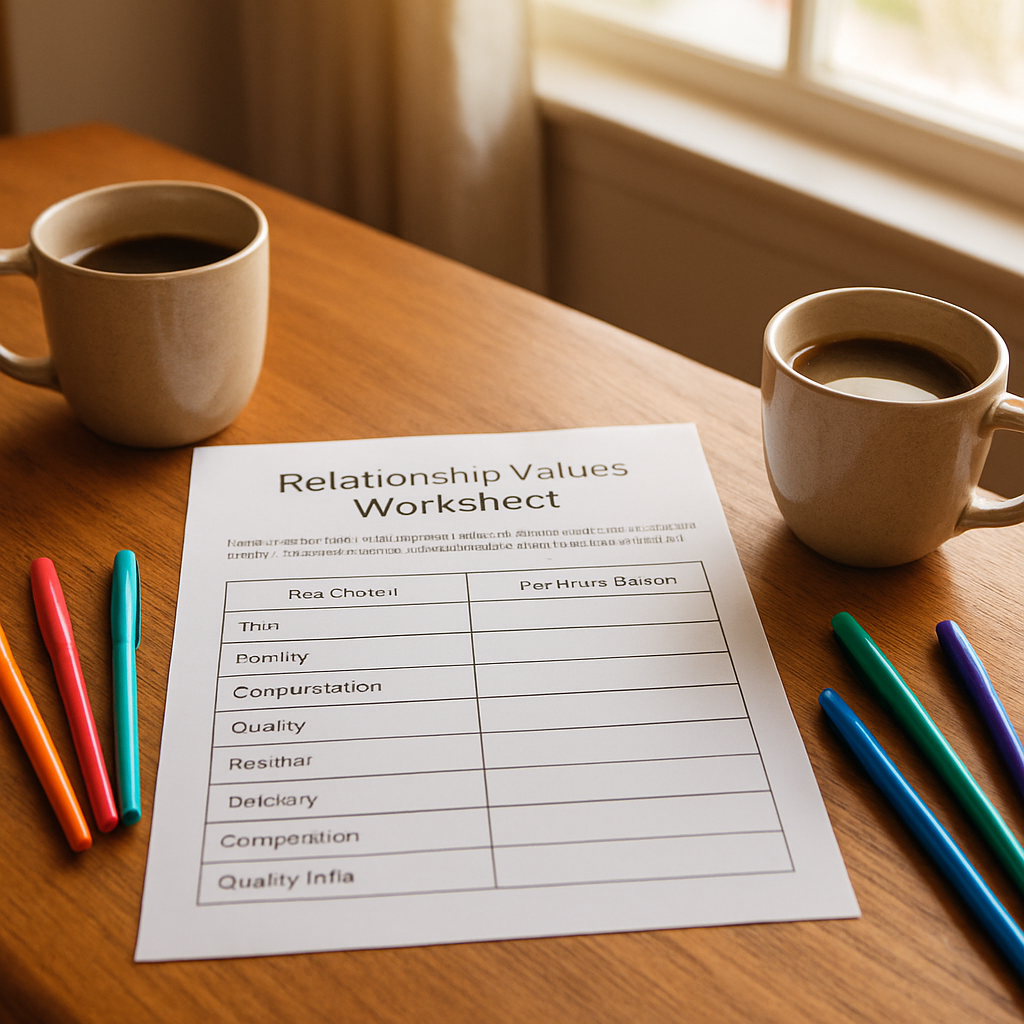
Step 2: Understand the Core Relationship Values
Now that you’ve got the worksheet in front of you, it’s time to dig into what really drives you both as a team. Think of core values as the hidden wiring behind every decision you make – from picking a Netflix show to planning a future home.
Why does it matter? When you can name those invisible forces, arguments shrink because you’re not fighting “what” you want, you’re aligning “why” you want it. Research on relationship satisfaction shows couples who regularly revisit their shared values report 30% fewer conflicts over finances and lifestyle choices.
Step‑by‑step: Pull the values out of the PDF
1. Open the worksheet together and read each prompt out loud. Pause after each question and ask, “What does this really mean for us?” Write the raw answer in the margin – no editing yet.
2. Swap papers. Highlight anything that surprised you in your partner’s list. Those surprise spots are often clues to values you didn’t know existed.
3. Bring both lists side by side and circle every word or phrase that appears on both pages. Those overlaps become your initial core values.
Real‑world example: Maya & Luis
Maya wrote “travel adventures,” “learning together,” and “spontaneous weekends.” Luis listed “financial security,” “family time,” and “travel adventures.” The only overlap was “travel adventures.” When they dug deeper, Maya explained she craved growth through new experiences, while Luis saw travel as a way to bond with his parents on family trips. By reframing the value as “shared growth through exploration,” they turned a potential clash into a joint goal – a yearly “culture weekend” that satisfies both.
Actionable checklist
- Set a timer for 20 minutes per prompt – keeps the conversation focused.
- Ask “Why is this important?” at least twice for each answer.
- Write a one‑sentence definition for each overlapping value (e.g., “Adventure = learning about the world together, not just ticking boxes”).
- Rank the top three values on a 1‑5 scale of importance to you both.
Notice how the simple act of defining each value turns vague ideas into concrete commitments you can refer back to during disagreements.
Probe deeper with targeted questions
Use a set of follow‑up questions to make sure you’re not just skimming the surface. For each overlapping value, ask:
- How would our lives look if we lived this value every day?
- What would we be willing to sacrifice for it?
- Which habits support it, and which pull us away?
These questions often reveal hidden trade‑offs. For instance, a couple might both value “stability,” but one interprets it as a steady 9‑to‑5 job while the other sees it as a predictable weekly date night. Naming those nuances prevents future friction.
Prioritize and make it visible
Once you’ve agreed on the top three, pick a visual anchor – a sticky note on the bathroom mirror, a shared phone wallpaper, or a small wooden token (you’ve seen the idea earlier). The goal is to keep the values in sight so they become part of everyday language.
And if you’re looking for a structured way to keep the conversation flowing, check out our Effective couples communication exercises pdf guide. It offers quick activities that turn abstract values into playful, repeatable rituals.
Set a regular “values check‑in”
Schedule a 15‑minute chat every month. Ask, “Do these three values still feel right?” If life has shifted – a new job, a move, a baby – adjust the wording, not the purpose. This habit turns the worksheet from a one‑off task into a living compass.
Finally, write down one concrete action you’ll take this week to honor each core value. Maybe it’s booking a weekend hike for “Adventure,” setting a weekly budget review for “Financial Security,” or planning a family game night for “Family Time.” When you see the worksheet, you’ll see a to‑do list that’s rooted in what truly matters.
Step 3: Fill Out the Worksheet Effectively
Alright, you’ve got the relationship values worksheet pdf open, the coffee’s hot, and the mood is set. The next question is: how do you actually turn those blank boxes into something that moves you both forward?
Here’s the truth – the worksheet is only as good as the conversation it sparks. If you treat it like a chore, you’ll get a list of buzzwords and no real change. If you treat it like a discovery expedition, you’ll surface the stuff that really matters.
1. Create a “Value‑Focused” Atmosphere
Start by agreeing on a tiny ritual. Maybe you light a scented candle, or you both put on the same playlist. The point is to signal, “We’re in this together, no distractions.” Put the timer on for 30 minutes – enough time to dig, but not so long you start scrolling on your phone.
And remember, it’s okay if the first pass feels messy. Use fragments, laugh at the odd answers, and keep the tone light. As PositivePsychology.com notes, structured worksheets boost engagement because they give clear, focused prompts.
2. Break Down Each Prompt
Read the first question aloud. Pause. Then ask, “What does this really mean for us?” Write the raw answer in the margin – no editing. Next, flip the page and do the same for your partner.
Example: Jenna wrote “freedom to explore new hobbies.” Mark said “financial security.” When they dug deeper, Jenna explained she meant “time freedom” – the ability to take a weekend class without worrying about money. Mark realized his “security” could include a small emergency fund that frees up that time. The overlap became a shared value: flexible stability.
3. Use the “Why‑Why” Drill
Take each raw answer and ask “Why?” at least twice. If the answer is “Because it makes me feel safe,” ask again, “Why does feeling safe matter?” You’ll often land on a deeper belief (e.g., “so we can plan a future together without anxiety”). Capture that deeper layer in a one‑sentence definition.
Write it next to the original value. This double‑layer approach turns vague ideas into concrete commitments you can reference later.
4. Prioritize with a Simple Rating Grid
Grab a sticky note and draw a 1‑5 grid. For each overlapping value, rate its importance to you both and its current fulfillment. The gap between importance and fulfillment is your “action priority.”
| Value | Importance (1‑5) | Current Fulfillment (1‑5) | Action Gap |
|---|---|---|---|
| Adventure | 5 | 2 | Plan a quarterly “mini‑trip.” |
| Financial Security | 4 | 3 | Set a joint budgeting night. |
| Quality Time | 5 | 4 | Create a weekly “date‑free‑screen” hour. |
This visual makes it clear which value needs immediate attention and which can wait.
5. Translate Values into Concrete Actions
For each top‑three value, write one specific, time‑bound action you’ll take this week. Think “book a hiking trail for Saturday” instead of “spend more time outdoors.” Put those action items right under the worksheet so they become a to‑do list, not a wish list.
Pro tip: use a shared Google Doc or a printed “values cheat‑sheet” that lives on your fridge. When you see it, you’re reminded to act.
6. Check In, Adjust, Repeat
Schedule a 15‑minute “values check‑in” after you’ve tried the first actions. Ask, “Did this feel right? Do we need to tweak the wording?” This habit turns the worksheet from a one‑off exercise into a living compass.
If you want a ready‑made set of questions to guide those check‑ins, our Relationship Check In Questions for Couples guide is a perfect companion.
7. Keep the Momentum with Mini‑Reviews
Every month, skim the worksheet and the action grid. Celebrate wins (even the tiny ones) and update any values that have shifted – maybe a new baby changed the weight of “family time.” The worksheet evolves with you.
And if you’re curious about how other couples make this habit stick, the Buy Google Reviews site offers a case study on how businesses keep feedback loops alive – the principle is the same: regular, honest reflection fuels growth.
Bottom line: filling out the worksheet isn’t a one‑time admin task. It’s a conversation, a rating exercise, and a weekly action plan rolled into one. Treat it with curiosity, and you’ll watch those values move from paper to daily life.
Step 4: Analyze Your Answers and Identify Patterns
Now that you’ve filled out the relationship values worksheet pdf, it’s time to step back and actually look at what the answers are saying.
First, gather both sheets and lay them out side by side. Do you see any words that keep popping up? Maybe “adventure,” “security,” or “family” appear on both pages. Those repeats are your first clues.
Tip: Highlight every overlapping term with a bright marker. When the color spreads across the page, you instantly see the patterns emerging.
But don’t stop at the obvious. Scan for subtle connections—like “flexibility” next to “financial security.” That could point to a deeper theme of “stable freedom.” Write that phrase in the margin.
Next, ask yourself a series of “why” questions. Why does “flexible stability” matter to you both? Why does “quality time” keep showing up? Jot down the answers; they become the narrative that drives your future actions.
Here’s a quick three‑step checklist to turn raw answers into clear patterns:
- List every value from both partners.
- Group similar values together (use synonyms, not exact matches).
- Rank each group by how many times it appears.
When you’ve ranked them, pick the top three clusters. Those are the values you’ll want to focus on this month.
Now, translate those clusters into actionable insights. For example, if “shared growth” is a top cluster, brainstorm concrete habits—like reading a book together every week or trying a new hobby monthly.
And if you need a structured way to keep those habits on track, check out our weekly relationship meeting template for couples. It gives you a simple agenda to review progress, celebrate wins, and tweak anything that feels off.
Don’t forget to capture any surprises. Maybe one partner listed “spontaneity” while the other emphasized “routine.” That tension can become a growth opportunity if you deliberately schedule a surprise date once a month.
Another useful trick is to assign a “satisfaction score” to each pattern. On a scale of 1‑5, rate how well you feel you’re living that value right now. The gap between the rating and the importance you just gave each value shows where the biggest action gap lies.
Once you have those gaps, create a mini‑action plan. Write a short sentence for each gap, like “Plan a quarterly weekend getaway to nurture adventure” or “Set up an automatic savings transfer for financial security.” Put that plan right next to the worksheet so you see it every day.
Finally, schedule a quick 10‑minute debrief with your partner at the end of the week. Ask, “Did we notice any new patterns?” and “What small win can we celebrate?” Those check‑ins reinforce the habit of pattern‑spotting and keep the worksheet alive.
Pro tip: pull the highlighted values into a simple spreadsheet, add a column for “current fulfillment,” and sort by the biggest gaps. Watching the numbers shift week by week feels surprisingly rewarding.

By turning raw answers into visual patterns, you give your relationship a map instead of a mystery. The next step will be to act on those patterns, but that’s a story for the next section.
Step 5: Use the Worksheet for Couples Communication
Now that you’ve spotted the patterns, it’s time to turn that paper into a real conversation engine. Think of the relationship values worksheet pdf as a gentle referee that keeps the dialogue fair, focused, and—most importantly—fun.
Pick a regular “talk‑time” slot
Schedule a 10‑ to 15‑minute window each week that’s just for the worksheet. It could be after dinner on Tuesdays, or during a Sunday coffee brunch. The key is consistency, not length. When the clock starts, both of you know the agenda: review the values, share what’s working, and flag what feels off.
Why does a set slot matter? Because life gets noisy, and without a dedicated moment the worksheet gets buried under laundry, emails, and Netflix queues. A tiny calendar invite turns the practice into a habit, and habits stick better than good intentions.
Start with a quick “temperature check”
Ask each other a simple rating: “On a scale of 1‑5, how alive does our value of adventure feel this week?” Keep it honest, even if the number is low. A low score is not a failure; it’s a signal that the next action needs tweaking.
Then, share one concrete example that illustrates the rating. For instance, “I gave us a 2 on quality time because we both worked late, but I did schedule a 30‑minute walk after dinner.” This tiny story bridges the abstract rating with lived experience.
Translate the rating into a micro‑action
Pick the highest‑gap value—where importance outruns fulfillment—and brainstorm one bite‑size step you can take before the next check‑in. If “financial security” scored a 3 on importance but a 1 on fulfillment, an actionable move might be: “Set up an automatic $50 transfer to our joint savings every payday.” Write that action directly on the worksheet next to the rating.
Notice the power of specificity: “save money” is vague; “transfer $50 each payday” is crystal clear. When you both see the same line, there’s less room for misinterpretation.
Use the worksheet as a conflict de‑escalator
When a disagreement pops up, pause and reference the worksheet. “Remember we both rated stability at a 4, but my stress is coming from the weekend plans.” By anchoring the talk in the shared values you’ve already agreed on, the conversation stays collaborative rather than combative.
It helps to have a “pause word”—maybe “values”—that signals, “Let’s bring the worksheet into this.” Both partners then flip to the relevant section and read the definition you wrote together. Suddenly the argument becomes a problem‑solving session about how to align actions with that value.
Celebrate the small wins
At the end of each session, give a quick shout‑out for anything that moved the needle, no matter how tiny. “We finally booked that hiking trail for adventure—nice work!” Celebrating reinforces the habit and builds positive momentum.
Even a 30‑second applause feels like a mini‑reward system. Over weeks, those celebrations add up and make the worksheet feel less like a chore and more like a shared victory board.
Keep the worksheet visible
After you finish a session, stick the updated page somewhere you’ll both see—on the fridge, the bathroom mirror, or a shared digital note. When the values are in sight, they creep into everyday decisions without you having to think about it.
And if you’re tech‑savvy, a simple cloud‑based PDF with comment permissions lets you add notes on the go, so the conversation can continue even when you’re apart.
By turning the relationship values worksheet pdf into a weekly communication ritual, you create a safe space to measure, tweak, and celebrate what matters most. It’s not just paper; it’s the soundtrack of a partnership that keeps getting better, one honest rating at a time.
Step 6: Printable Templates and Additional Resources
Alright, you’ve got the relationship values worksheet pdf filled out, you’ve talked through the numbers, and now you need something you can actually hold, mark up, and pull out whenever a decision pops up.
Why a printable template is a game‑changer
There’s something about paper that makes a promise feel real. When you print a template, you can underline, doodle, or slap a sticky note on the spot. A digital file is handy, but a printed page sits on the fridge, on the nightstand, and becomes part of your daily rhythm.
Research shows that structured worksheets boost engagement because they give clear, focused prompts you can act on SimplePractice notes. In other words, the act of printing turns an idea into a tangible tool you actually use.
Grab a ready‑made printable
Start by downloading a free printable template that mirrors the layout of your values worksheet. Look for a “relationship expectations worksheet” that already has sections for values, rating scales, and action gaps. You can find one on SimplePractice’s resource page – just hit the download button and save it to a folder you’ll remember.
Once it’s on your screen, print two copies (one for each of you) or a single double‑sided sheet if space is tight. Choose a good‑weight paper so the markers don’t bleed through; it feels nicer to write on, too.
Customize it for your relationship values worksheet pdf
Open the printed page and replace the generic prompts with the specific values you identified in earlier steps. For example, if “Adventure” and “Flexible Stability” topped your list, write those headings in the top left box.
Next, add a quick rating column: 1‑5 for importance and 1‑5 for current fulfillment. This mirrors the gap analysis you already did, but now it’s right on the page you’ll glance at every morning.
Don’t forget a “next action” row. Instead of vague ideas like “talk more,” write concrete tasks – “book a weekend hike for Saturday” or “set up a $50 joint savings transfer each payday.” When the action is specific, you’re far more likely to follow through.
Bundle with extra resources
Now that the template is your new “values cheat‑sheet,” consider pairing it with a few low‑effort add‑ons:
- Sticker or magnet anchor. Slip the sheet into a magnetic pocket on your fridge or attach a small adhesive hook on the bathroom mirror.
- Mini‑journal. Keep a pocket‑size notebook beside the worksheet to jot quick reflections – “Did we hug more today?” or “Did we skip the argument about chores?”
- Digital backup. Scan the finished page and store it in a shared cloud folder. That way, if the paper gets coffee‑stained, you still have a clean copy.
These tiny extras keep the habit alive without feeling like a chore.
How to use the printable in everyday life
Pick a regular “values check‑in” moment – maybe after dinner on Tuesdays. Pull the printable, glance at the rating column, and ask each other a quick question: “How alive does our adventure value feel this week?” A one‑sentence answer and a tiny action item keep the conversation focused and purposeful.
If a rating drops, use the “next action” row to brainstorm a micro‑step you can both agree on. The sheet becomes a living to‑do list, not a static document.
When you travel or stay overnight, tuck the printed page into your bag. It’s a reminder that your shared values travel with you, guiding decisions from restaurant choices to budgeting conversations.
Bonus: printable expectations worksheet for deeper dives
If you ever hit a snag where expectations feel fuzzy, the printable relationship expectations worksheet from SimplePractice offers additional prompts around boundaries, communication styles, and conflict resolution. Slip those prompts into your existing values sheet and you’ve got a hybrid tool that covers both “what we value” and “how we show up.”
Bottom line: a printable template turns the abstract relationship values worksheet pdf into a hands‑on, visual cue you see every day. Print it, personalize it, and pair it with a few simple accessories, and you’ll find the worksheet quietly steering your choices without a single reminder.
Conclusion
We've walked through why the relationship values worksheet pdf feels less like paperwork and more like a shared adventure.
First, downloading the PDF gave you a quiet space to be honest. Then you unpacked core values, spotted patterns, and turned vague ideas into concrete actions. Those steps turned a simple sheet into a living compass for everyday decisions.
Notice how the printable version turned abstract thoughts into something you can actually touch—sticking it on the fridge, scribbling next‑step notes, or slipping it into your travel bag. That tactile reminder keeps the conversation flowing even when life gets busy.
So, what’s next? Pick a day this week, pull the worksheet, and ask each other, “How alive does our adventure value feel right now?” Write down one tiny step you’ll take before the next check‑in. Tiny wins build momentum.
Remember, the worksheet isn’t a one‑time task; it’s a habit that grows with you. When you revisit it regularly, you’ll see conflicts shrink, alignment sharpen, and love deepen.
If you’re hungry for more guided exercises or printable templates, Happy Together has a growing library of resources to keep the momentum going. Keep the values visible, keep the dialogue honest, and watch your partnership thrive.
Take the first step today, and let the worksheet be the map that guides your journey together toward a richer, more connected future.
FAQ
What is a relationship values worksheet pdf and why should we use it?
A relationship values worksheet pdf is a printable guide that helps you and your partner uncover the core beliefs that drive your decisions—things like adventure, security, or quality time. By writing them down, you turn vague feelings into concrete language you can refer back to during disagreements or planning sessions. The act of filling it out together also builds trust because you’re literally putting your priorities on paper, which makes future conversations feel less like guesswork and more like a shared roadmap.
How often should we revisit the worksheet to keep it useful?
Most couples find a monthly “values check‑in” works well: set a 15‑minute timer, glance at the top three values, and ask each other a quick rating (1‑5) on how alive those values feel. If life throws a curveball—new job, a baby, a move—use that moment as an excuse to adjust the wording. The key is consistency; a brief, regular review prevents the worksheet from gathering dust and turns it into a living compass rather than a one‑time task.
Can the worksheet help us with money talks?
Absolutely. When you see “financial security” side‑by‑side with “adventure,” you can spot where the tension lies. For example, Maya and Luis discovered they both valued travel, but Luis framed it as a savings goal while Maya saw it as spontaneous fun. By rewriting the value as “shared growth through exploration,” they agreed on a concrete step: allocate a modest travel fund each month. That specific action bridges the gap between the two perspectives and makes money discussions feel collaborative.
What if one partner is uncomfortable sharing their values?
Start with a low‑stakes prompt like “What’s a small habit that makes you feel seen?” rather than diving straight into deep topics. Give each other 5 minutes to write without interruption, then swap papers. Seeing the raw, unfiltered answers often reduces anxiety because the words are already on the page. If discomfort persists, agree to revisit the worksheet after a few weeks—sometimes the simple act of having it in front of you softens the resistance.
How do we turn the worksheet’s insights into daily habits?
After you’ve identified your top three values, create a “next‑action” row right under each one. Instead of “spend more time together,” write something measurable like “schedule a 30‑minute walk after dinner on Tuesdays.” Put that sheet on the fridge or a shared digital note so you see it every day. When the action becomes part of your routine, the abstract value solidifies into a habit you both experience.
Is a printable version better than a digital one?
Many people swear by the tactile feel of paper. When you can underline, doodle, or stick a sticky note right on the worksheet, the ideas feel more real. A study of worksheet engagement shows that physical interaction boosts recall and commitment. If you’re tech‑savvy, you can still scan the finished page and store it in a cloud folder as a backup—but keep the original printed copy in a high‑traffic spot for maximum impact.
What should we do if our values drift apart over time?
Values evolve, and that’s normal. When you notice a widening gap—say “family time” drops from a 5 to a 2—you can use the worksheet as a diagnostic tool. Ask each other why the shift happened and brainstorm a micro‑step to reconnect, like a weekly “family game night” or a shared calendar reminder. Revisiting the worksheet every few months gives you a built‑in pulse check, so you can adjust before the drift turns into resentment.