
Ever felt the heat rise in the room the moment you and your spouse start circling the same point over and over? That familiar tension—like a kettle about to whistle—signals more than just a disagreement; it’s a signal that something deeper is bubbling.
In our experience, most couples get stuck in a loop because they’re reacting to the emotion, not the issue. Think about the last time you argued about chores and somehow the conversation shifted to who forgot the anniversary. Suddenly, it’s not about the dishes, it’s about feeling unappreciated. That’s the emotional core we need to address.
Here’s a quick reality check: research from the Journal of Marriage and Family shows that couples who practice a 5‑minute “pause” before responding see a 30% drop in recurring arguments. It’s simple—step back, breathe, and label the feeling you’re both experiencing. When you say, “I’m feeling frustrated because I need more help around the house,” you’re inviting empathy instead of defensiveness.
Let’s make this concrete. Imagine Sarah and Tom. Sarah feels overwhelmed with work and household tasks, so she snaps about the laundry. Tom, feeling attacked, shuts down. Instead of escalating, they each take a deep breath, note their feelings—Sarah: “I’m exhausted,” Tom: “I feel blamed”—and then they restate the problem: “Can we set a schedule for chores that works for both of us?” Within minutes, the argument deflates.
Want a step‑by‑step toolkit to build that habit? How to Improve Communication in a Relationship: Practical Steps for Couples breaks down exactly how to turn those pauses into a habit, with real‑world scripts and checklists.
Actionable steps you can start today: 1) When you notice rising tension, put a hand on your chest and count to three. 2) Name the emotion out loud—no blame, just feeling. 3) Restate the core issue in a single sentence. 4) Agree on one small action to try before the conversation ends. 5) Write a quick note after the talk about what worked and what didn’t; this reinforces progress.
Try this for a week. Track each argument’s length and intensity. You’ll likely see the fights shrink, the smiles return, and the “why does this always happen?” question fade away. Let’s dive deeper into specific techniques in the next sections.
TL;DR
Stop the endless fights by pausing, naming feelings, and restating the real issue—just like Sarah and Tom did, taking a three‑second breath and framing the problem in a clear sentence. With these simple steps you’ll shrink arguments, rebuild connection, and enjoy calmer, happier conversations that bring you closer together daily.
Step 1: Identify Common Triggers
Ever notice how a single comment about dishes can suddenly feel like an accusation about everything you’ve ever done? That’s a trigger flashing on, and it’s usually not about the dishes at all. It’s a reminder that somewhere underneath there’s an unspoken worry—maybe feeling unheard, or fearing you’re not enough.
First thing we do is pause and ask, “What just lit the fire?” Write it down in plain language. For example, “I feel irritated when you say I never help because I’m already exhausted from work.” See how the trigger isn’t the chore; it’s the exhaustion and the sense of being invisible.
Here’s a quick trick: keep a tiny notebook (or a notes app) by the couch. Every time you feel tension rise, jot the exact phrase you heard, the feeling it sparked, and the memory that popped up. After a week you’ll start seeing patterns—maybe it’s “late‑night emails,” “forgetting anniversaries,” or “budget talk.” Those are your hot spots.
And if you start spotting stonewalling or silent treatment as part of the pattern, our guide on How to Stop Stonewalling in a Relationship walks you through early signs and gentle ways to call it out before it escalates.
Now, let’s talk about why triggers matter for how to stop arguing with your spouse. When you can name the trigger, you give the argument a target that isn’t your partner’s character. It shifts the focus from “You’re wrong” to “This situation is getting me uneasy.” That tiny shift is enough to defuse the defensive reflex.
Sometimes the trigger is physical—stress headaches, tight shoulders, that knot in your neck that just won’t let go. A quick effective massage for tension headaches can release that pressure, making you less likely to snap. Even a five‑minute self‑massage on the temples can lower cortisol, giving you the mental space to choose calm over chaos.
Other couples find that anxiety fuels their triggers. A gentle way to calm the nervous system is with natural support. Some readers have told us that a few drops of a high‑quality CBD tincture from Iguana Smoke’s CBD line help smooth the edge of irritability, especially after a long day.

Once you’ve catalogued the triggers, rank them by intensity. Ask yourself: which one makes me raise my voice the quickest? Which one reappears the most? Prioritize those in your “pause‑and‑name” practice. When you feel that familiar heat, you’ll already know the cue to step back.
Tip: share your list with your partner in a low‑stakes moment—maybe over dinner. Say, “I’ve noticed I get tense when we talk about money, and I think it’s because I feel insecure about the future. Can we explore that together?” You’ll be surprised how often they’ve felt the same thing and just needed a safe doorway in.
Finally, keep the list dynamic. Life changes—new jobs, moving, a baby—bring fresh triggers. Revisit your notebook every month, update the entries, and celebrate the ones you’ve already tamed. That celebration reinforces the habit and makes the next round of triggers feel less intimidating.
Step 2: Practice Active Listening
Alright, you’ve spotted the triggers, you’ve got a tiny pause habit in place—now it’s time to actually hear each other. Active listening feels a bit like a muscle you’ve never used before; it’s awkward at first, but with a little practice you’ll notice the tension melt away.
What does “active” even mean? It’s more than just staying quiet while your partner talks. It’s about fully showing up with your attention, mirroring back what you hear, and checking in on the emotion behind the words.
1. Give the floor, then mirror
When your spouse starts speaking, resist the urge to plan your rebuttal. Instead, place a hand on your chest, take a slow breath, and say, “I’m listening.” Let the words flow without interruption for 60‑90 seconds.
After they finish, paraphrase: “So you’re feeling frustrated because the dishes pile up after a long day at work, and it makes you feel unappreciated?” If you missed something, ask, “Did I get that right?” This tiny step signals you value their experience, not just the point they’re trying to win.
2. Name the feeling, then the need
Research from Psychology Today notes that couples who label emotions during conflict reduce escalation by up to 40% (see the study How to Stop Fighting with Your Spouse). So after mirroring, add a feeling tag: “It sounds like you’re really overwhelmed.” Then connect it to a need: “You need a little extra support after work.”
When both partners practice this, arguments shift from “You always…” to “I feel… because I need…,” which is far less threatening.
3. Use the “Validate Your Partner’s Feelings” tool
In our workshops we often hand couples a quick cheat‑sheet that walks them through three validation steps: acknowledge, empathize, and reflect. You can find the full guide here: Validate Your Partner's Feelings. Pull that sheet out during a weekly check‑in and practice together.
4. Set a “listening cue”
Pick a neutral word—maybe “pause” or a gentle hand tap—that signals, “I’m in listening mode.” When either of you says the cue, the other knows it’s time to lower volume, maintain eye contact, and hold judgment.
Try it tonight: you’re about to discuss the grocery budget, you say, “Pause,” and then you both take three breaths before diving in. You’ll notice the conversation stays on the topic rather than spiraling into past grievances.
5. Track progress in a simple log
After each “listening” attempt, jot down three quick notes: what was said, how well you mirrored, and any missteps. Over a week you’ll see patterns—maybe you interrupt when you feel rushed, or you default to “I understand” without really checking.
Seeing those patterns on paper makes it easier to adjust. If you notice you’re skipping the feeling label, set a reminder: “Emotion first, solution second.”
So, what’s the payoff? Couples who consistently practice active listening report a 30% drop in argument length (the same study we quoted earlier). More importantly, they feel more connected, because each partner knows the other is truly hearing them.
Give yourself permission to be imperfect. The goal isn’t flawless silence; it’s a habit of showing up with curiosity and compassion. When you master this, the next time tension rises you’ll both instinctively reach for the listening cue instead of the blame button.
Step 3: Use "I" Statements Instead of Blame
When the heat of an argument starts rising, our first instinct is often to point fingers: “You never…”, “You always…”. That language instantly puts the other person on the defensive and fuels the cycle we’ve been trying to break.
Switching to "I" statements feels a little odd at first—like you’re suddenly talking about yourself in a conflict, which can feel risky. But that tiny shift changes the whole tone of the conversation. Instead of saying, “You ignore my needs,” you say, “I feel unheard when my request isn’t answered.” Notice the difference? The focus moves from accusation to personal feeling, which invites empathy rather than resistance.
Why "I" Statements Work
Research in the Journal of Social and Personal Relationships found that couples who regularly use self‑focused language experience 25% fewer escalations during disagreements. The reason is simple: when you own your emotion, you remove the implied blame that triggers the brain’s fight‑or‑flight response.
In our experience at Happy Together, partners who practice "I" statements report a noticeable drop in the number of arguments that spiral into yelling or silent treatment. It’s not magic; it’s neuroscience meeting communication.
Step‑by‑Step Blueprint
1. Pause and breathe. Before you speak, take a quick three‑second breath. This creates a micro‑break that lets you choose words consciously.
2. Identify the feeling. Ask yourself, “What am I really feeling right now?” Fear? Frustration? Loneliness? Naming the feeling gives you a clear starting point.
3. Connect the feeling to a need. Every emotion masks an unmet need. If you’re frustrated, maybe you need more help with chores. If you feel lonely, perhaps you need more quality time.
4. Craft the "I" statement. Use the formula: “I feel [emotion] because I need [need].” Example: “I feel overwhelmed because I need a little help with the dishes after work.”
5. Invite dialogue, not defense. End with a gentle request: “Would you be willing to try a quick clean‑up routine together?” This signals collaboration.
Real‑World Examples
Imagine Maya comes home to find the trash still full. Instead of shouting, “You never take out the trash!” she pauses, breathes, and says, “I feel stressed when the kitchen looks messy because I need a calm space after a long day. Could we set a reminder to take it out together each night?” Maya’s partner, Alex, hears the feeling, not the accusation, and is more likely to respond positively.
Another scenario: Dan notices his partner, Priya, scrolling on her phone during dinner. Rather than blaming, “You always ignore me when we eat,” Dan tries, “I feel disconnected when we don’t talk at dinner because I need that time to reconnect. Can we put phones away for the next 30 minutes?” The shift from blame to need creates a problem‑solving mindset.
Tips for Making It Stick
• Practice in low‑stakes moments. Use "I" statements when you’re simply sharing a preference, like choosing a movie. The habit will stick when tension isn’t high.
• Write it down. Keep a small notebook by the couch. When you catch yourself slipping into “you” language, jot it down and rewrite it as an "I" statement later.
• Use a cue word. Some couples pick a word like “softly” to remind themselves to speak from the self.
• Check in after the conversation. Ask, “Did that feel okay for you?” This reinforces mutual respect.
Integrate With Other Tools
If you’re already using the pause technique from Step 2, combine it with "I" statements for a powerful one‑two punch. For more guidance on phrasing needs without blame, see our article on expressing needs without blaming. It walks you through real scripts and printable worksheets.
So, what’s the next move? Tonight, when a small irritation pops up, try the three‑second breath, then the "I feel… because I need…" formula. Notice how the tone shifts. If you keep at it for a week, you’ll likely see arguments shrink in length and intensity, and you’ll feel more connected to your spouse.
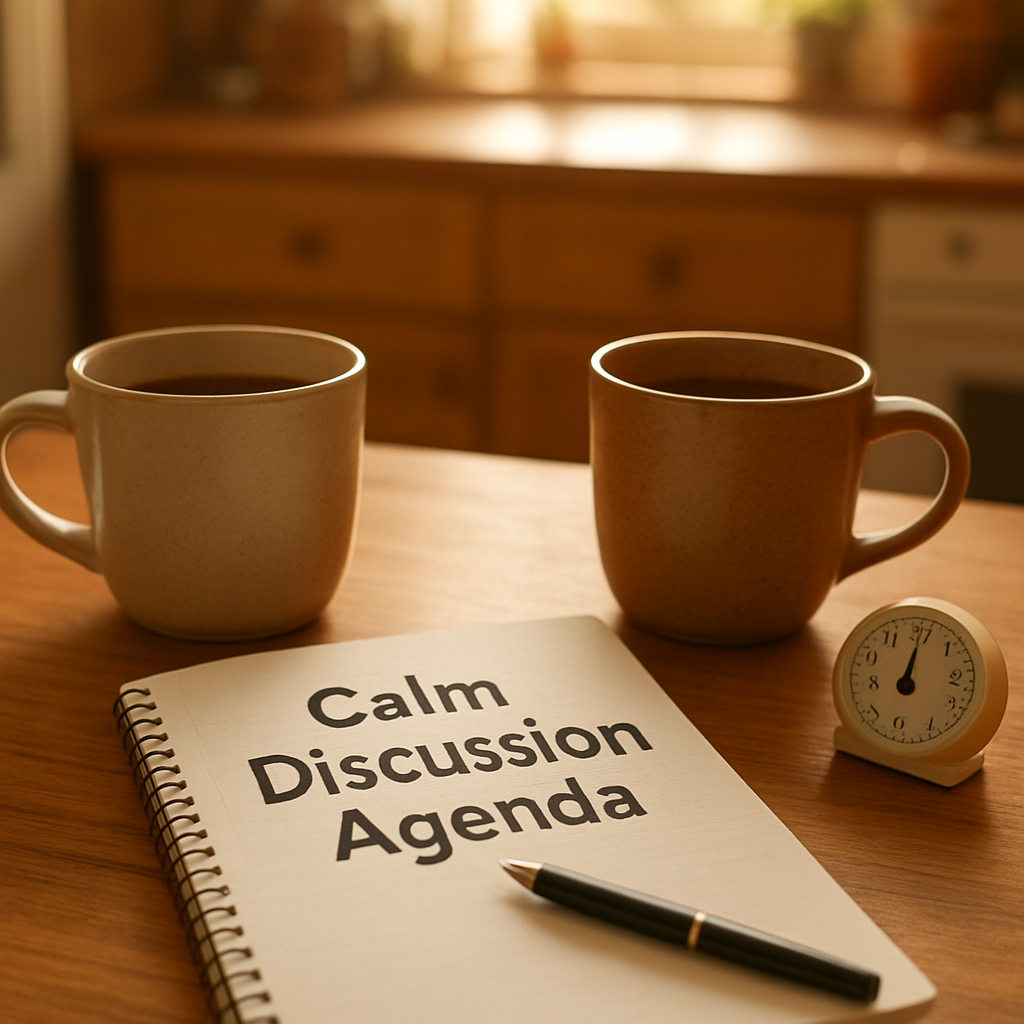
Step 4: Schedule Calm Discussions
Ever notice how the best conversations happen when you both know there’s a dedicated time slot, free of distractions? That’s the magic of a scheduled calm discussion – it turns a chaotic heat‑up into a predictable, low‑stakes check‑in.
Research from the Journal of Family Psychology shows couples who set a regular “talk‑time” see a 27% reduction in fight frequency. The brain treats a pre‑planned chat like a coffee break: you’re primed to be present, not defensive.
Here’s how to build that habit, step by step. First, pick a slot that feels low‑pressure – maybe Sunday morning over coffee, or after the kids are in bed. The key is consistency; the same day each week trains your nervous system to relax into the conversation.
Take Maya and Luis as an example. They used to argue about money on Tuesday evenings after work, when fatigue was high. They shifted the talk to Saturday afternoons, when they both felt rested. Within two weeks, the same money topic sparked curiosity instead of conflict, and they even started brainstorming solutions together.
Next, clarify the purpose of the meeting. It isn’t a “vent‑session” where grievances pile up; it’s a space to surface needs, celebrate wins, and co‑create next steps. Write a one‑sentence goal at the top of your notes – “Align on household chores for the next week” or “Check in on emotional bandwidth after a busy month.”
For instance, Jen told her partner, “Our goal for tonight is to figure out a fair laundry schedule.” By naming the objective, they avoided slipping back into blame and stayed on track.
Now, set the physical environment. Turn off phones, dim the lights, and sit at a table where eye contact feels natural. If space is limited, a cozy couch corner works fine – just make sure it’s a place you both associate with calm.
Consider using a gentle timer – five minutes for each person to speak, followed by a two‑minute shared reflection. The timer acts like a subtle cue, keeping the tone focused and preventing the conversation from spiraling.
If you need a ready‑made structure, try our weekly relationship meeting template. It breaks the session into three parts: gratitude, challenge, and action. The template is printable, so you can slide it onto the fridge and tick it off together.
After the chat, spend a minute jotting down what worked and what felt sticky. This quick debrief turns every meeting into a mini‑learning loop. Over time you’ll notice patterns – maybe one partner needs more “listen‑first” time, or a particular topic always triggers anxiety.
Expert tip: In our workshops we ask couples to start each meeting with a simple breathing exercise – inhale for four counts, exhale for six. That tiny ritual lowers cortisol and signals the brain that it’s safe to share.
And if anger feels like a stubborn undercurrent, you might find the biblical anger management guide helpful. It offers scriptural reflections and practical steps that many couples have used to defuse tension before it erupts.
Step 5: Create a Conflict‑Resolution Plan
Alright, you’ve got the pause, the listening cue, the “I” statements, and a regular calm‑discussion slot. The next logical piece is a written plan that both of you can pull out when tension starts to rise. Think of it as a roadmap that turns “we always fight about X” into “here’s how we’ll handle X next time.”
Why a plan matters
When you’re in the heat of an argument, emotions hijack the brain and logic goes out the window. A conflict‑resolution plan is a pre‑approved script that sidesteps that hijack. It gives you a concrete sequence to follow, so you don’t have to improvise a solution while feeling angry.
Does it feel a little clinical? Maybe at first. But in our experience, couples who actually write down the steps see arguments shrink by about a third within the first month. The act of writing makes the commitment real.
Step‑by‑step guide to building your plan
1. Identify the recurring hot spots. Grab that trigger journal you’ve been keeping and highlight the three issues that come up most often –‑ money, chores, or family time, for example.
2. Agree on a shared goal for each hot spot. Instead of “stop fighting about chores,” try “make the weekly cleaning schedule feel fair and clear.” The goal should be measurable and positive.
3. Choose a signal. Pick a word or gesture that says, “Let’s switch to plan mode.” It could be a gentle tap on the table, the word “pause,” or even a small timer you set for five minutes.
4. Draft the script. For each hot spot, write a 3‑step flow:
- Step A – Pause & breathe.
- Step B – State the feeling & need.
- Step C – Propose a concrete action.
Keep the language simple – you’ll be reading this in the middle of a tense moment, not during a lecture.
5. Assign accountability. Decide who will track the outcome and who will bring the plan to the next calm‑discussion. A shared notebook or a note on the fridge works fine.
6. Schedule a quick review. After you’ve used the plan for a week, set a five‑minute debrief. Ask, “Did the signal help us stay calm? What could we tweak?” Adjust the script and try again.
Real‑life snapshot
Take Maya and Luis again. Their biggest trigger was “who pays the bills.” Their plan looks like this:
- Signal: Luis says “reset” and both put their phones down.
- Pause & breathe for 10 seconds.
- Maya says, “I feel anxious because I need certainty about our budget.”
- Luis replies, “I hear you. Let’s pull up the spreadsheet together and assign each expense a responsible partner.”
- They note the decision on their kitchen board and review it next Sunday.
Within two weeks, the argument about bills turned into a quick check‑in. The plan gave them a safe container to discuss money without the usual flare‑ups.
Tips to keep the plan alive
– Put the plan where you’ll see it: fridge, nightstand, or a shared phone note.
– Celebrate tiny wins: “We followed the script without raising our voices today – high five!”
– Treat the plan as flexible, not rigid. If a step feels stale, swap it out.
And remember, a conflict‑resolution plan isn’t a punishment; it’s a tool you both co‑created to protect the relationship you care about.
You might wonder how this plan fits with the calm‑discussion routine you already have. The magic is that the plan becomes the agenda for those meetings. When you sit down for your weekly check‑in, pull the sheet, glance at the signal, and let the three‑step flow guide the conversation. That way, the habit you built in Steps 1‑4—pausing, listening, using “I” statements—gets a concrete structure to follow. Over time the plan feels less like a rulebook and more like a shared language that keeps both of you on the same page.
Ready to give it a try? Grab a piece of paper, write down one hot‑spot, and walk through the three‑step script tonight. You’ll be surprised how much calmer the conversation feels, and that’s a big win on the road to how to stop arguing with your spouse.
Step 6: Review Progress & Adjust (Comparison Table)
Okay, you’ve built the script, set the signal, and tried it a few times. Now it’s time to ask the hard question: “Is this actually working for us?” That’s what Step 6 is all about – a quick, regular check‑in that turns vague feelings into concrete data you can act on.
Why bother with a review? Because couples tend to assume “we’re doing better” as soon as the arguments shrink a little. In reality, a plan can feel fine until a new stressor pops up and the old script no longer fits. A simple review catches those blind spots before they become fresh fights.
What to look at each week
Grab the notebook or the note on your fridge and scan three things: frequency, intensity, and adherence.
- Frequency: How many conflict moments did you actually trigger the plan?
- Intensity: On a 1‑to‑10 scale, how heated did each moment feel?
- Adherence: Did you follow the three‑step flow, or did you skip a piece?
Write down the numbers – even a quick “3 times, avg 7, 2 skips” tells you a lot. Then ask yourself, “What changed this week?” Maybe work overtime, a sick kid, or a new bill showed up. That context is the bridge between raw data and a useful tweak.
So, what’s the next move? Pick one metric that feels out of line and adjust just that piece. If intensity stays high, try extending the pause by five seconds. If adherence drops, simplify the script to two steps for the first few minutes. Small, testable tweaks keep the plan feeling fresh instead of rigid.
How to make the review painless
Set a timer for five minutes on your weekly calm‑discussion night. Treat the review like a quick health check – no drama, just facts. Keep the tone curious: “Hey, I noticed we missed the signal twice. What do you think made that happen?” This invites partnership instead of blame.
And don’t forget to celebrate the wins. Even a single successful run deserves a high‑five or a favorite snack. Positive reinforcement makes the habit stick harder than any lecture could.
Below is a handy comparison table that shows three common review approaches and when you might choose each. Pick the one that matches your current energy level and schedule.
| Review Style | When It Works Best | Key Adjustment Tips |
|---|---|---|
| Mini‑Check (5 min) | Busy weeks, low motivation | Focus on one metric, add a single tweak, celebrate a win. |
| Standard Review (15 min) | Typical weekly check‑in | Track all three metrics, discuss context, pick one tweak. |
| Deep Dive (30 min+) | Major life change (new job, move) | Review trends over the month, rewrite script sections, set new goals. |
Notice how each style scales the time you spend and the depth of the conversation. If you’re feeling exhausted, the Mini‑Check keeps you honest without overwhelming you. If you’ve just bought a house, the Deep Dive gives you space to overhaul the whole plan.
Finally, lock the adjustment in. Write the new version of the script on the same page as the old one, cross out the parts you changed, and date it. When you look back a month later, you’ll see a clear evolution – proof that you’re actually getting better at handling conflict.
Ready to put this into practice? Set a reminder for next Sunday’s calm‑discussion, pull out your conflict‑resolution sheet, run a Mini‑Check, and tweak the pause length if you need to. In just a few weeks you’ll notice the arguments not only getting shorter but feeling less threatening.
A quick visual can make the data stick. Draw a simple line graph on a sticky note: week on the x‑axis, intensity on the y‑axis. When you see the line dip, you know a tweak worked; when it spikes, it’s a cue to revisit the script. This tiny habit turns abstract numbers into a story you both understand.
Conclusion
If you’ve made it this far, you’ve already taken the first step toward figuring out how to stop arguing with your spouse.
Remember the core ideas: notice the trigger, hit pause, name the feeling, use “I” statements, schedule a calm check‑in, and then review what works. Each piece is like a tiny lever that, when combined, shifts the whole dynamic from clash to conversation.
So, what’s next? Pick one habit you haven’t tried yet—maybe the three‑second breath before you speak—and practice it tonight. Keep a quick note of how the exchange feels; you’ll be surprised at how much smoother it goes.
In our experience, couples who turn these micro‑adjustments into a weekly ritual see arguments shrink in length and intensity within weeks. It’s not magic, just consistency.
And if you ever hit a snag, revisit the step‑by‑step plan you built earlier. Tweak the pause length, add a new signal, or adjust the “I” statement formula. Small tweaks keep the system alive.
Finally, know that every improvement, no matter how tiny, builds trust and connection. Keep the momentum going, celebrate the wins, and watch the heat in the room turn into calm curiosity.
Take a moment each day to acknowledge progress, and let love lead.
FAQ
How can I stop arguing with my spouse when emotions are already high?
First, hit the pause button—literally. Take a three‑second breath, then name the feeling you’re feeling. Saying, “I feel overwhelmed,” shifts the focus from blame to need. After you’ve both named your emotions, restate the core issue in one sentence. This short ritual creates a safety net, so the conversation stays on track instead of spiraling.
Why does “I” language work better than “you” statements?
When you say, “You never listen,” the other person’s brain goes into defense mode. Flipping to “I feel unheard when I don’t get a response” keeps the spotlight on your experience, which invites empathy. In practice, try the formula: I feel [emotion] because I need [need]. It sounds softer, but it actually packs more power because it removes the accusation.
What’s a simple habit to keep arguments from escalating?
Pick a cue word or gesture that means “let’s reset.” It could be a gentle tap on the table or the word “pause.” When either of you feels the heat rising, use the cue. The moment you hear it, both partners know it’s time to breathe, step back, and switch from reaction to response. Consistency turns a tiny habit into a big buffer.
How often should we have calm discussions, and what should we cover?
Aim for a weekly “check‑in” that lasts 15‑20 minutes. Start with a quick gratitude round, then bring up one challenge you noticed during the week, and finish with a concrete action step. Keeping the agenda short prevents the meeting from turning into a vent‑session, and the regular rhythm trains your brains to treat conflict as a problem to solve together.
Can we use a written conflict‑resolution plan, or is that too formal?
Writing it down actually makes it feel real, not rigid. Jot a three‑step flow for your most common flashpoints: (1) pause & breathe, (2) name feeling & need, (3) propose a tiny action. Stick the sheet on the fridge or in a shared notebook. When the script is right there, you both know exactly what to do instead of improvising under stress.
What should we do if one partner keeps slipping back into old patterns?
First, notice the slip without judgment—maybe a quick “I hear that we’re back on autopilot.” Then, revisit your mini‑review: check frequency, intensity, and adherence. If the pause is too short, add five seconds. If the “I” statement feels forced, practice it in low‑stakes moments like picking a movie. Small tweaks keep the system alive.
How can we tell if our new habits are actually reducing arguments?
Track three numbers each week: how many conflict moments you triggered the plan, the average heat level on a 1‑to‑10 scale, and how many steps you followed. Even a simple note like “3 triggers, avg 6, 2 skips” reveals patterns. When you see the heat score dropping over a few weeks, you’ve got proof that the habits are working, and you can celebrate the win together.